
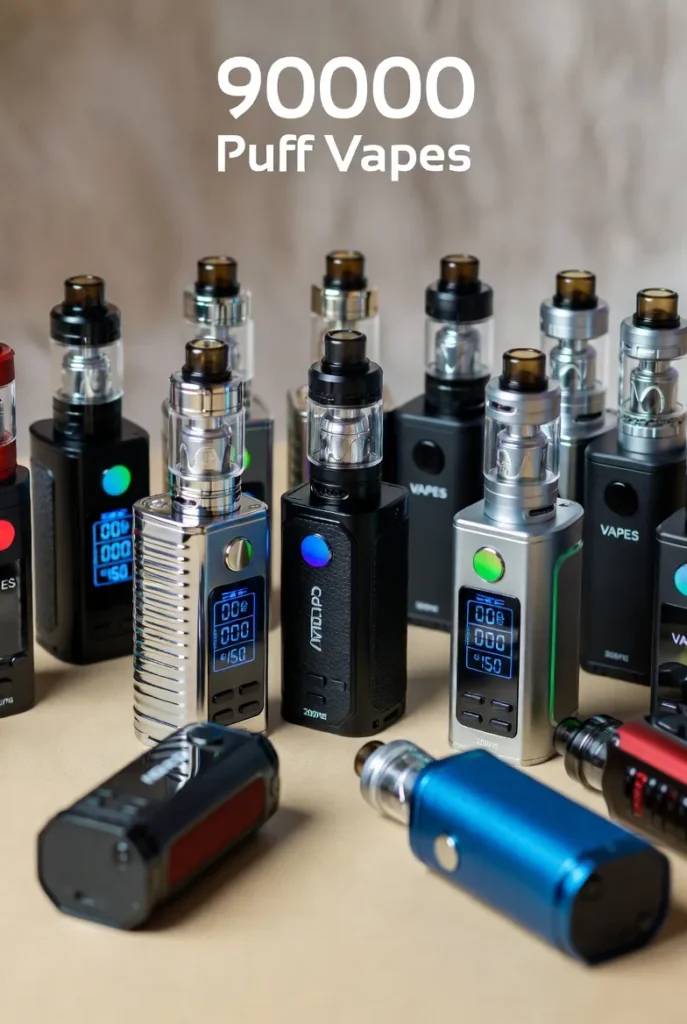
9000 Puff Vapes
Are 9000 puff vapes illegal?
The legality of a 9000‑puff vape depends on your country or region and how the product complies with local rules. Many markets allow disposable vapes if they meet regulatory requirements, such as age limits, safety standards, and labeling. However, authorities are tightening regulations.
In the United Kingdom, retailers cannot sell or supply single‑use disposable vapes (non‑refillable, non‑rechargeable) after June 1, 2025, regardless of nicotine content. This rule also applies to high‑puff devices unless they qualify as reusable or refillable under the law.
In the United States, the FDA still requires marketing authorization for e‑cigarette products. Many flavored disposable vapes have faced enforcement actions. Unauthorized products can be seized, and retailers may receive warnings.
Owning or using a 9000‑puff vape may not be illegal in every area, but selling or distributing devices that violate regulations can lead to legal trouble. Always check your local laws before buying or selling.
How long does a 9000 puff last?
“9000 puffs” is a device’s advertised maximum puff count — but real‑world lifespan varies significantly based on personal use patterns:
- Light users sampling occasionally may stretch a 9000‑puff device to up to ~40 days.
- Moderate users often see around 3–5 weeks of use.
- Heavy or frequent vapers may exhaust the device in about 2–3 weeks.
These estimates assume average draw strength and typical puff frequency; your actual experience can differ.
Is vaping safer than smoking cigarettes?
We don’t know for certain. However, current evidence suggests that vaping likely exposes users to fewer chemicals and toxins than traditional cigarettes.

Pamela Ling, MD, MPH
Director of the UCSF Center for Tobacco Control Research and Education
Observational studies indicate that the risk of lung disease appears to be lower for people who vape compared to smokers. On the other hand, studies so far show that the risk of cardiovascular disease may be similar between vaping and smoking.
As for lung cancer, we don’t have definitive data yet. While it’s hoped that vaping carries a lower risk, it can take 10–20 years for lung cancer to develop, so long-term evidence is still unavailable.
Believe It or Not, 1 Vape has 20 Cigarettes Worth of Nicotine
How many cigarettes equal 9000 puffs?
Comparing vaping puffs to cigarettes is not an exact science. Nicotine delivery varies widely depending on the device, nicotine strength, inhalation depth, and other factors. However, we can make rough estimates.
A typical cigarette provides about 10–15 puffs on average.
Research shows that a single high‑nicotine vape pod can deliver roughly the same amount of nicotine as a full pack of cigarettes (around 20 cigarettes). This can vary depending on the product and how the user vapes.
Using a simple comparison, if one cigarette equals about 12 puffs, 9000 puffs could theoretically equal around 750 cigarettes. Keep in mind, though, that this estimate is imprecise. Vapes and cigarettes deliver nicotine and other chemicals differently. It’s more useful to consider overall nicotine intake and health effects than to focus solely on puff counts.
Is 20 vape puffs a day bad?
Comparing vaping puffs to cigarettes is not exact science because nicotine delivery varies widely by device, nicotine strength, how deeply you inhale, and other factors. However, rough approximations are possible:
- A typical combustible cigarette yields about 10–15 puffs on average.
- Some research estimates that one vape pod at high nicotine strengths can deliver about the same nicotine as a pack of cigarettes (about 20 cigarettes), though this varies by product and use pattern.
By one simple comparison metric, if one cigarette equals ~12 puffs, then 9000 puffs could theoretically be compared to ~750 cigarettes — but this kind of calculation is highly imprecise because vaping devices and cigarette smoke deliver nicotine and other chemicals differently. It’s better to think in terms of nicotine intake and health effects rather than puff count equivalence.
Can lungs heal after 7 years of vaping?
Proof of long‑term recovery from vaping is limited and ongoing research is needed, but what evidence exists suggests:
- Smoking cessation, even after many years, can lead to measurable lung healing (improved lung capacity and less inflammation), and some same principles apply to quitting vaping — the body begins to clear inhaled chemicals once use stops.
- However, vaping also exposes lungs to potentially harmful chemicals (including flavorings that may cause inflammation or other damage). The long‑term consequences of many years of vaping are not fully known, because these products have not been around as long as combustible cigarettes.
In short, if someone stops vaping, the lungs may begin to repair — particularly regarding inflammation and mucus clearance — but irreversible damage from chronic exposure cannot be ruled out and depends on individual factors.
 English
  Deutsch
  Français
  Italiano
  Español
  Nederlands
  Polski
  日本語
日本語  Čeština