
The vaping hardware landscape has undergone a structural transformation. For years, vaporizers were engineered primarily as nicotine-delivery mechanisms, optimizing rapid salt absorption and throat hit. However, consumer demand has expanded toward flavor-driven exploration, recreational cloud production, and smoking cessation routines where nicotine is eliminated entirely. This shift has elevated the 0% nicotine category from a secondary offering into a specialized hardware segment.
Early zero-nicotine devices were often small, non-rechargeable disposables. Their fixed lithium cells invariably drained before vaporizing the entire e-liquid reservoir, leading to inconsistent aerosol density, muted flavor, and premature disposal. In 2026, the market standard has shifted toward high-capacity, rechargeable zero-nicotine platforms. By pairing sizable pre-filled or refillable reservoirs with USB-C charging circuitry, these devices maintain consistent voltage regulation from the first puff to the last drop of liquid.
The Engineering Behind Modern Zero-Nicotine Hardware
Vaporizing a 0% nicotine formulation presents distinct physical and chemical requirements compared to standard nicotine salt solutions. Nicotine salts provide a natural throat hit and interact with aromatic compounds at relatively low temperatures. In contrast, zero-nicotine liquids consist purely of vegetable glycerin (VG), propylene glycol (PG), and concentrated flavorings. To deliver a satisfying sensorial experience, the atomizer must produce a dense, homogeneous vapor cloud without scorching delicate flavor esters.
Modern rechargeable devices address this requirement through specialized heating geometry and electrical regulation:
- Low-Resistance Mesh Coils: By replacing traditional coiled wire with perforated metallic mesh sheets (typically ranging between 0.8 Ω and 1.2 Ω), the heating element achieves instantaneous thermal distribution across a broader surface area of organic cotton wicking. This prevents localized hotspots that cause acrid burnt hits.
- Regulated Voltage Output: Integrated chipsets ensure that power delivery remains constant across fluctuating battery discharge curves. Instead of experiencing weak vapor when the cell drops below 3.7V, users receive consistent wattage until the microcontroller signals a recharge.
- Optimized Capillary Action: Because zero-nicotine e-liquids frequently feature higher VG ratios (60% to 70%) for maximum cloud density, modern intake ports are wider, facilitating rapid wicking and preventing dry hits during continuous sessions.
Core Technical Pillars of Modern Rechargeable 0% Vapes
Key engineering innovations defining modern rechargeable zero-nicotine hardware:
- ✓USB-C Rapid Power Delivery Enables sustained battery output across multiple charging cycles, preventing voltage drop and weak vapor production as the reservoir depletes.
- ✓Dual Mesh Coil Architecture Distributes heat evenly across organic cotton wicks, preventing burnt hits and maximizing flavor purity from nicotine-free vegetable glycerin and propylene glycol formulations.
- ✓Real-Time Smart Displays Provides active telemetry showing exact battery percentage and e-liquid levels to eliminate dry burning and unexpected device failure.
- ✓Extended Capacity Reservoirs Engineered with leak-resistant transparent or semi-transparent tanks holding 15 ml to 25+ ml of 0% e-liquid for prolonged operational life.
High-Capacity Rechargeable Formats vs. Open Pod Systems
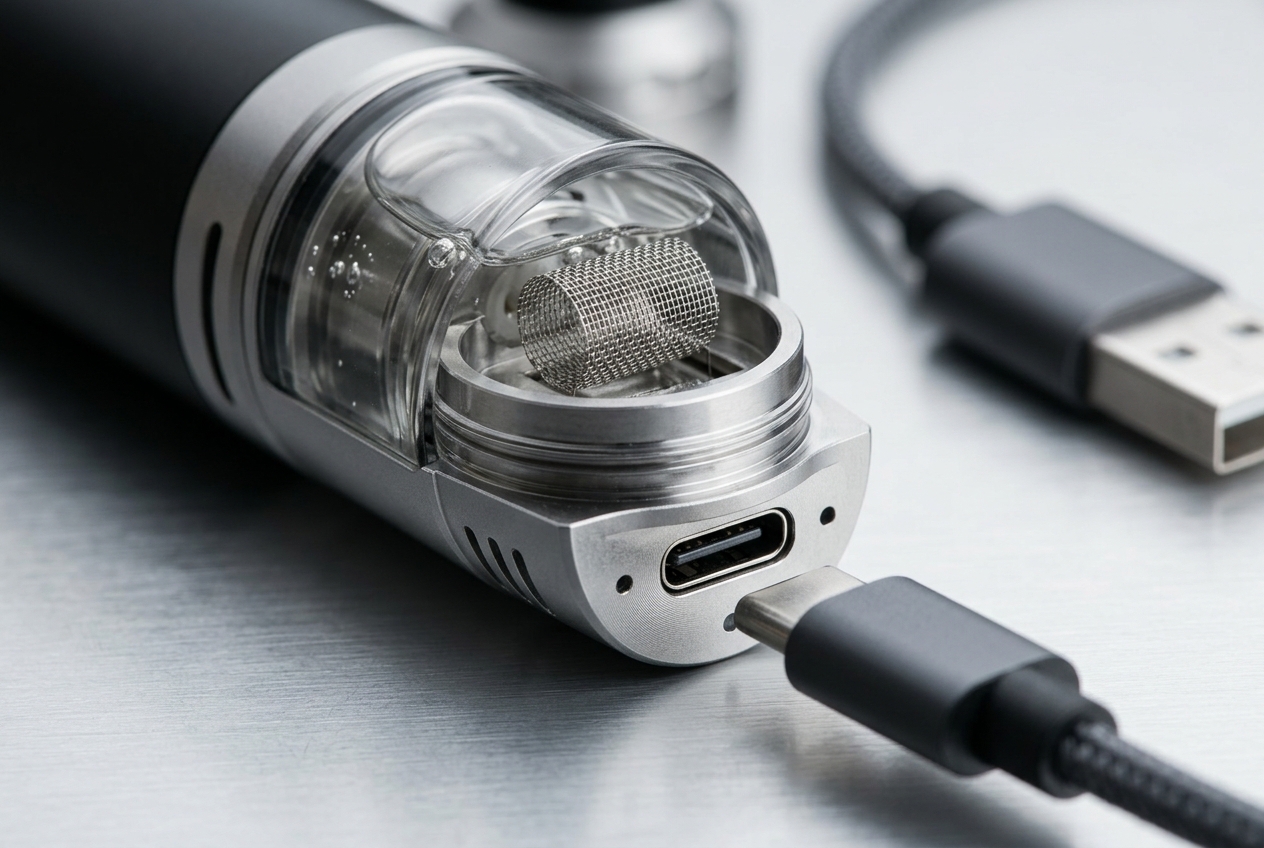
When selecting a rechargeable zero-nicotine setup in 2026, users primarily navigate two distinct hardware categories: high-capacity rechargeable pre-filled devices and refillable open pod systems. Understanding their architectural differences ensures an informed hardware choice.
Pre-Filled High-Capacity Rechargeable Devices
Often referred to as large-format rechargeable disposables, these units integrate a factory-sealed e-liquid reservoir (ranging from 15 ml up to 25 ml or more) with a rechargeable 650 mAh to 850 mAh battery. As explored in our deep dive on zero-nicotine disposable and rechargeable vape technology, their primary advantage is turnkey convenience coupled with zero maintenance. The coil, airflow channel, and liquid viscosity are calibrated at the factory for optimal performance.
However, their sealed nature means that once the pre-filled reservoir is fully depleted, the entire unit must be recycled. While USB-C recharging eliminates battery waste during the liquid’s lifespan, users cannot change flavor profiles on demand.
Open Pod Refillable Systems
Open pod systems feature a permanent battery mod and replaceable, refillable pods or sub-ohm coils. Users purchase zero-nicotine shortfill or 10 ml e-liquids separately. This architecture delivers complete control over liquid composition, flavor switching, and airflow customization. The trade-off lies in routine maintenance: users must manually refill reservoirs, monitor coil degradation, and clean condensation from contact pins.
Key Technical Criteria for Selecting a 0% Device
Evaluating rechargeable zero-nicotine hardware requires assessing several performance metrics rather than relying solely on manufacturer puff estimates. Critical technical factors include:
Airflow Regulation and Draw Resistance
Zero-nicotine vaping relies heavily on airflow dynamics to simulate tactile resistance or create airy cloud production. Devices featuring mechanical airflow toggles allow users to alternate between a tight Mouth-to-Lung (MTL) draw—ideal for those transitioning away from smoking—and a looser Restricted Direct-to-Lung (RDL) draw that enhances aroma perception.
Battery Telemetry and Smart Indicators
In line with broader European vaping technology trends, modern platforms incorporate smart digital displays. A numeric LED screen showing real-time battery percentage and estimated liquid levels prevents the frustration of dry burns or unexpected power depletion.
Transparent Tank Architecture
Traditional sealed disposables concealed the internal cotton wick, leaving users guessing when liquid was running low. Modern chassis designs increasingly favor transparent or semi-translucent reservoir sections. Direct visual verification protects the internal mesh coil from firing when dry.
2026 Device Comparison: Leading Rechargeable Architectures
Hardware manufacturers have released several notable zero-nicotine compatible platforms that illustrate how these engineering features translate into daily performance.
Fumot Tornado Box Pro 22000
O Fumot Tornado Box Pro 22000 exemplifies modern visual reservoir design. Built with a transparent tank and an integrated 0.9 Ω mesh coil, it allows users to monitor e-liquid levels continuously. Its onboard LED screen tracks battery life, while the USB-C port provides rapid recharging for its internal battery, ensuring consistent aerosolization across up to 22,000 puffs.
Fumot Digital Box 12000
For users seeking a more pocket-friendly profile with precise monitoring, the Fumot Digital Box 12000 balances a 20 ml pre-filled volume with an 850 mAh rechargeable battery. It features an integrated smart digital display for both battery percentage and liquid reserves, backed by adjustable airflow control at the base of the chassis.
Stagbar Nexus 60000
At the highest end of endurance engineering, platforms like the Stagbar Nexus 60000 represent the ultra-capacity format. Designed with advanced chipset regulation, dual-mesh switching, and continuous graphic telemetry, it maintains stable power output across extended lifespans, eliminating the progressive flavor fading common in smaller hardware.
Best Practices for Battery Longevity and Flavor Retention
Maximizing the performance of rechargeable zero-nicotine hardware requires proper operating and charging habits:
- Avoid High-Wattage Fast Chargers: Standard 5V/1A or 5V/2A charging blocks are recommended over proprietary ultra-fast laptop or phone chargers (65W+). High-current chargers can overheat small internal lithium cells and degrade battery capacity.
- Allow Wicking Recovery Between Puffs: Zero-nicotine liquids with high VG ratios require a few seconds between draws to saturate the inner cotton wick. Rapid chain-vaping can lead to premature dry spots on the mesh coil.
- Store at Moderate Temperatures: Extreme heat thins e-liquids and increases leak risk, while severe cold thickens the solution and inhibits proper wicking. Storing devices between 15°C and 25°C preserves coil integrity and battery chemistry.
By understanding coil resistance, battery management, and reservoir design, consumers can select a zero-nicotine rechargeable device that delivers optimal flavor purity and dependable performance throughout 2026.
 English
  Deutsch
  Français
  Italiano
  Español
  Nederlands
  Polski
  日本語
日本語  Čeština
  Português